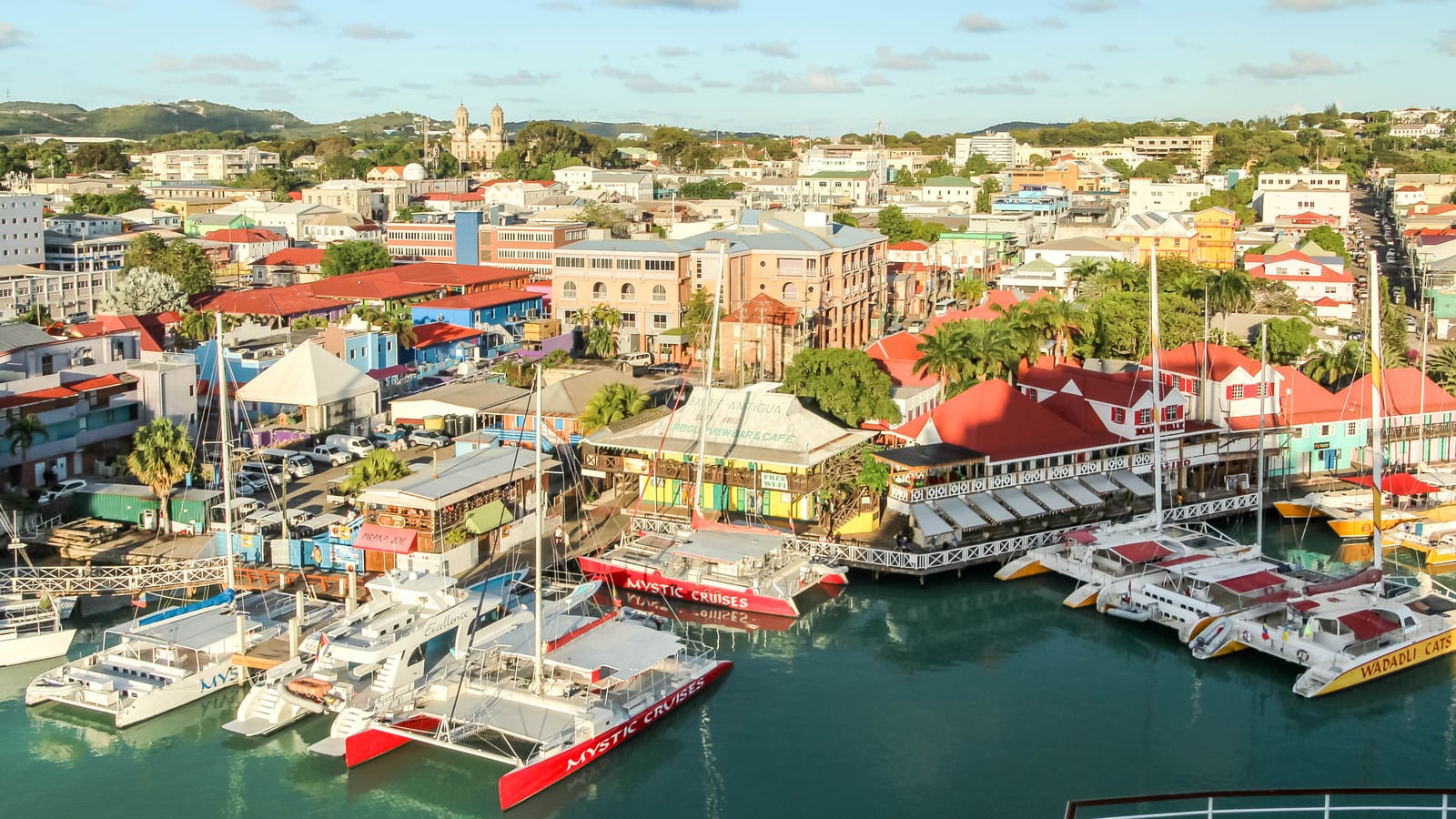
Almost everyone arrives at V.C. Bird International Airport (ANU), 8 km north-east of St John’s, or steps off a cruise ship at Heritage Quay right in the capital. Getting to Barbuda is a separate decision, and the one that needs planning.
Flying to Antigua
V.C. Bird International (ANU) is a proper regional hub with a modern terminal opened in 2015. Direct long-haul services run year-round from London Gatwick and Heathrow (British Airways, Virgin Atlantic), from Miami, New York, Charlotte, Atlanta and Newark (American, JetBlue, Delta, United) and from Toronto (Air Canada, WestJet), with extra winter capacity from December to April.
From continental Europe you will normally connect through London, or fly to another Caribbean hub. Regional carriers link Antigua with almost every island in the Lesser Antilles, which makes it a natural first or last stop on a multi-island trip.
- Airport code: ANU · about 20 minutes from St John’s and Dickenson Bay
- 35 minutes to Jolly Harbour, 45 minutes to English Harbour
- Taxis run a fixed government tariff — agree the fare before you set off
- Departure tax is included in your ticket price
Arriving by cruise ship
Ships dock at Heritage Quay, the Nevis Street Pier or the Deep Water Harbour, all within walking distance of central St John’s. That is unusually convenient: the cathedral, the market, the museum and Redcliffe Quay are all a few minutes on foot.
For a beach or the dockyard you need transport. Fixed-tariff taxis wait at the pier, and organised excursions pick up at Heritage Quay — the ones designed for cruise passengers say so explicitly and guarantee a return time. On a short call, the trolley-train city loop with a water taxi to the beach is the most efficient use of a few hours.
Getting to Barbuda
The Barbuda Express catamaran runs from St John’s to River Dock in about 90 minutes. It does not sail every day, it does not sail in rough weather, and the schedule changes — book ahead and confirm the day before. The crossing can be lively; take something for seasickness if you are prone.
Light aircraft cover the same distance in about 15 minutes from V.C. Bird International. It costs considerably more and is far more reliable, which matters if you are day-tripping. A guided day tour handles the booking, the transfers and a driver on the island, and is usually the least stressful way to do it.
Getting around Antigua
Driving is on the left, and a temporary local driving permit is required — around US$20, issued on the spot by the car hire company with your home licence, valid for three months. Roads are paved but potholed in places, junctions are often unsignposted, and goats have right of way in practice if not in law.
Minibuses run from the West Bus Station in St John’s down the west and south coasts, and from the East Bus Station to the east. They cost a couple of US dollars, leave when full rather than to a timetable, do not serve the airport and barely run on Sundays. Taxis are unmetered but government-tariffed: ask for the rate before you get in.
- Drive on the left; temporary local permit required (~US$20, 3 months)
- Minibuses ~EC$4–5, no Sunday service, no airport route
- Taxis: fixed government tariff, agree the fare first, cash preferred
- Water taxis link Nelson’s Dockyard with Galleon Beach and St John’s with the beaches